
You searched for your own business on Google Maps – and your competitor showed up instead. Sound familiar?
If your business is not appearing in the top results on Google Maps, you are not just losing visibility. You are losing real customers, real phone calls, and real revenue every single day – to businesses that may not even be better than yours. They just rank higher.
In 2026, the rules of local search have changed dramatically. Google’s March 2026 spam update cracked down on fake reviews, keyword-stuffed business profiles, and low-quality local content harder than ever before. At the same time, AI-powered tools like Google AI Overviews, Gemini’s Ask Maps, ChatGPT, and Perplexity have started recommending local businesses directly inside their answers – without the user even clicking a single search result.
This means one thing: if your business is not optimized for both Google Maps and AI search, you are invisible to a growing chunk of your potential customers.
But here is the good news. Ranking on Google Maps is not about luck, big budgets, or technical complexity. It comes down to a clear, repeatable strategy — and that is exactly what this guide gives you.
According to Google Consumer Insights, 46% of all Google searches have local intent, and 76% of people who search for something nearby visit that business within 24 hours. Businesses sitting in the Google Maps Top 3 capture over 70% of all local clicks. That top spot is not just a vanity metric — it is the difference between a fully booked calendar and an empty one.
This complete Local SEO Guide walks you through every step — from setting up and optimizing your Google Business Profile, to building genuine reviews and local authority, to creating content that ranks in both traditional search and AI-generated answers. Whether you run a shop in Bareilly, a service business in Lucknow, or a digital agency anywhere in India, this guide is built for real results.
Table of Contents
What Is Local SEO and Why Does It Matter in 2026?
Local SEO – or Local Search Engine Optimisation – is the practice of optimizing your business’s online presence so that Google shows it to nearby customers when they search for your product or service. It is the difference between being found and being invisible. When someone types “SEO expert near me” or “digital marketing agency in Bareilly,” local SEO determines whether they find you or your competitor.
Unlike traditional SEO, which focuses on ranking nationally or globally for broad keywords, local SEO is laser-focused on geographic relevance. It uses signals like your location, business category, customer reviews, and local content to connect you with people who are searching with buying intent – right in your area.
Think of it this way: traditional SEO gets you found by anyone, anywhere. Local SEO gets you found by the right person, at the right time, in the right place – and that customer is usually ready to act immediately.
Where Local Results Appear in 2026
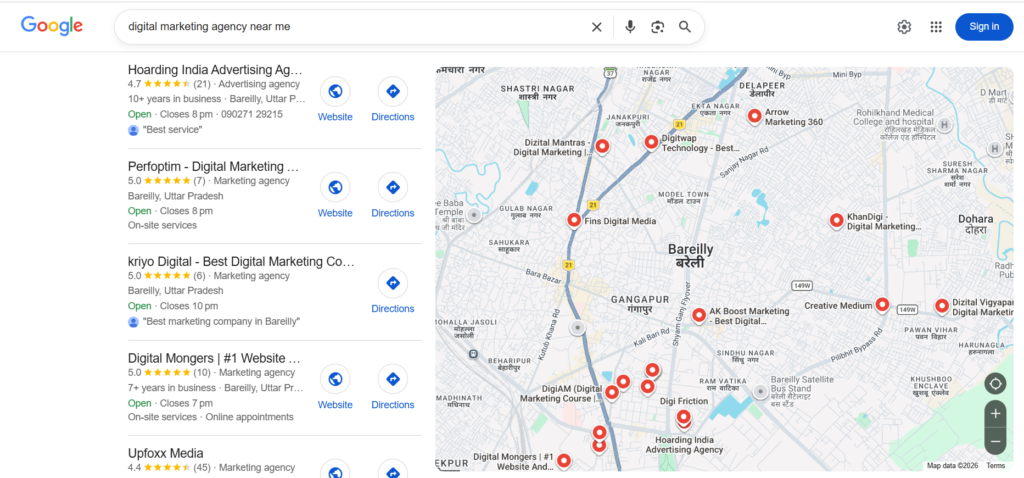
This is where 2026 is fundamentally different from previous years. Local search is no longer limited to a small box with three map pins. Today, your business needs to be visible across five discovery channels, and each one operates differently.
This is exactly what the Google Map Pack looks like — the top 3 local business listings that capture 70%+ of all local clicks. Your goal is to own one of these three spots.
The businesses optimized for all five channels completely dominate their local market in 2026. Those who only focus on traditional Map Pack rankings will steadily lose visibility as AI search continues to grow.
Why 2026 Is a Pivotal Year for Local Businesses
Two major forces are reshaping local search simultaneously in 2026.
Google’s March 2026 Spam Update
Google deployed one of its most aggressive local spam enforcement actions in March 2026. The update specifically targeted fake reviews, keyword-stuffed GBP names, duplicate location pages with copied content, and businesses using PO Box addresses to fake local presence. The message from Google is unmistakable — authenticity is now the primary currency of local SEO.
AI-Powered Local Search
Google AI Overviews now appear at the very top of search results — above the Map Pack, above all organic listings — for a growing number of local queries. If your business is not optimized for AI visibility, you are losing the most premium spot on the entire search results page.
How Google Ranks Local Businesses: The 3 Core Pillars
Before diving into tactics, you need to understand the foundation. Google uses three core signals to determine which businesses appear in the local Map Pack and Google Maps results.
Proximity is the one pillar you cannot fully control. Your business is where it is. However, strong Relevance and Prominence signals can help you rank for searches from nearby areas even when you are not the closest option.
The 2026 Local Search Ranking Factors data reveals the exact weight each signal carries:
- GBP Signals: 32% — the single biggest factor
- Review Signals: 20%
- On-Page Website Signals: 15%
- Behavioral Signals: 9%
- Link Signals: 8%
- Citation Signals: 6%
- Personalization: 6%
- Social Signals: 4%
Now let us act on each of these, step by step.
Step 1: Optimize Your Google Business Profile
Your Google Business Profile is one of the most important assets for boosting your local SEO as a digital marketing agency. It is the first thing potential clients see when they search for services like yours — whether they type “digital marketing agency near me” or “SEO expert in Bareilly.”
If your profile is not set up properly, you are missing out on valuable leads, calls, and business opportunities every single day. Here is how to get it right.
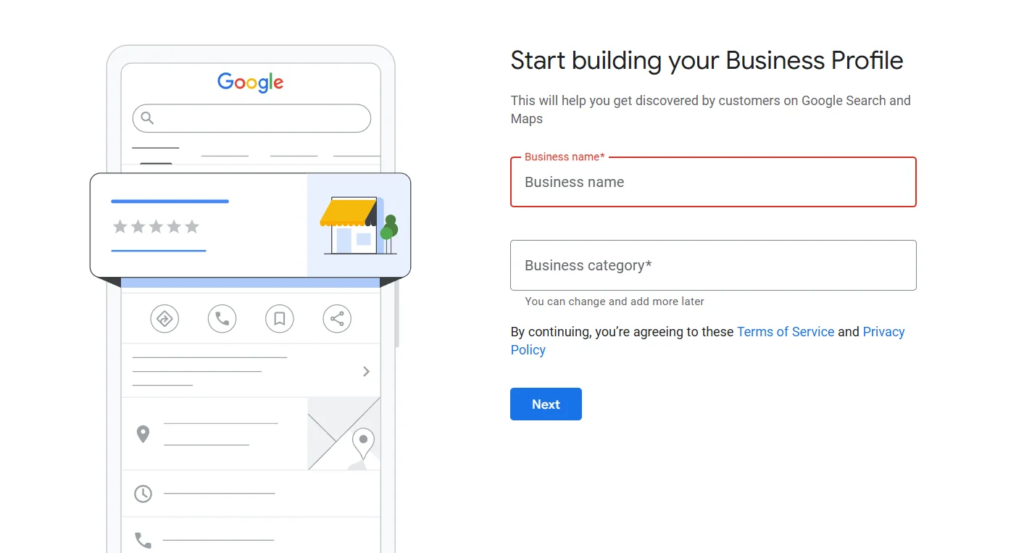
Claim and Verify Your Profile
Before you can optimize your Google Business Profile, you need to claim and verify it. This process ensures you control the information shown to potential clients and directly helps your agency appear in local search results. Verification is crucial because it tells Google your business is legitimate — which immediately boosts your visibility in the local Map Pack and Google Maps results.
Here is what you need to do:
- Go to the Google Business Profile page and click “Manage Now”
- Enter your agency’s details — business name, address, and phone number (NAP)
- Verify your business via mail, phone, video, or email — whichever option Google offers for your location
- Once verified, you gain full control of your profile and can begin adding all the information that drives local rankings
Once your profile is verified, you can start adding the relevant details that will improve your visibility for high-intent searches like “social media marketing agency in [your city]” or “best SEO agency near me.”
Add Practice Areas/Services and Photos
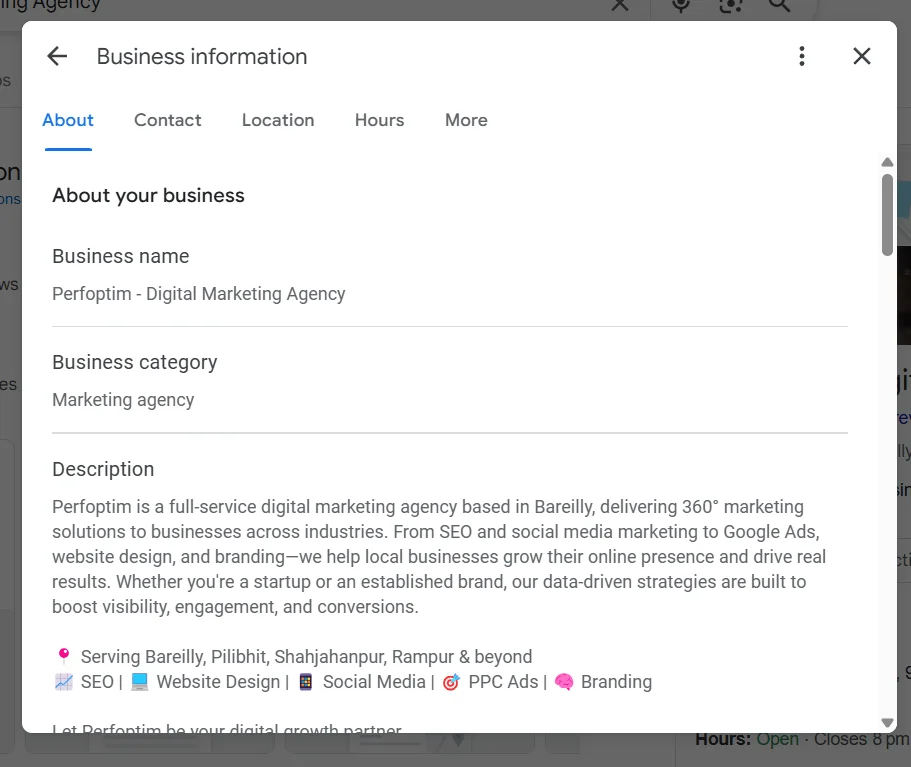
Now that your profile is verified, it is time to make it work for you. One of the most impactful steps is adding your service offerings in detail. This is crucial for local digital marketing SEO, as it helps Google understand exactly what your agency does — from SEO and Google Ads management to social media marketing and website design.
What to add:
- A clear, keyword-rich business description mentioning your core services — naturally include phrases like “digital marketing agency,” “local SEO services,” and your target city
- Individual service listings — add each service separately with its own name and description, such as Search Engine Optimization, Google Ads Management, Social Media Marketing, Content Marketing, and Website Design
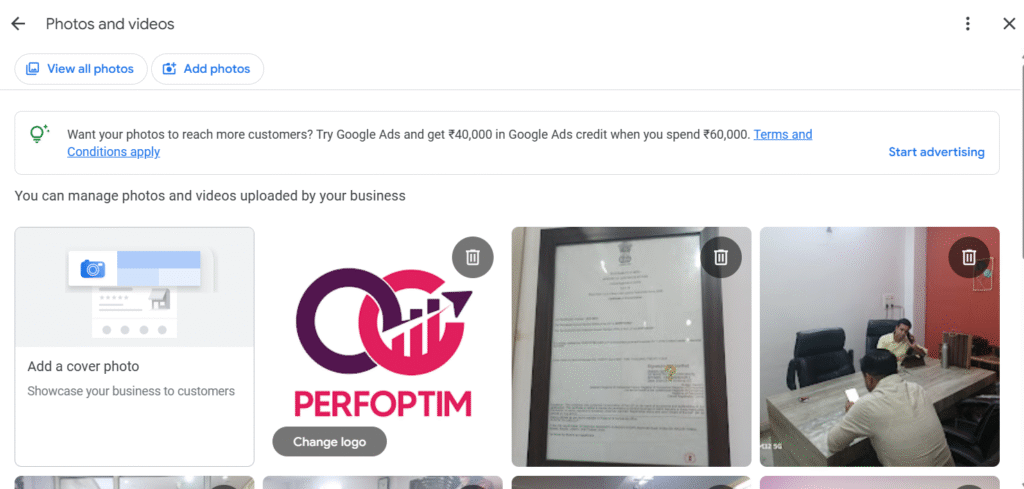
- High-quality photos — upload images of your office, your team in action, client meeting setups, workspace environment, and any events or workshops you have hosted. Photos build credibility and trust instantly
- Client results or portfolio screenshots (where applicable) — real work builds real trust
The more complete and visually rich your profile, the better your agency will rank in local search. Google specifically rewards profiles that are detailed, active, and filled with relevant, genuine information.
Post Weekly Updates
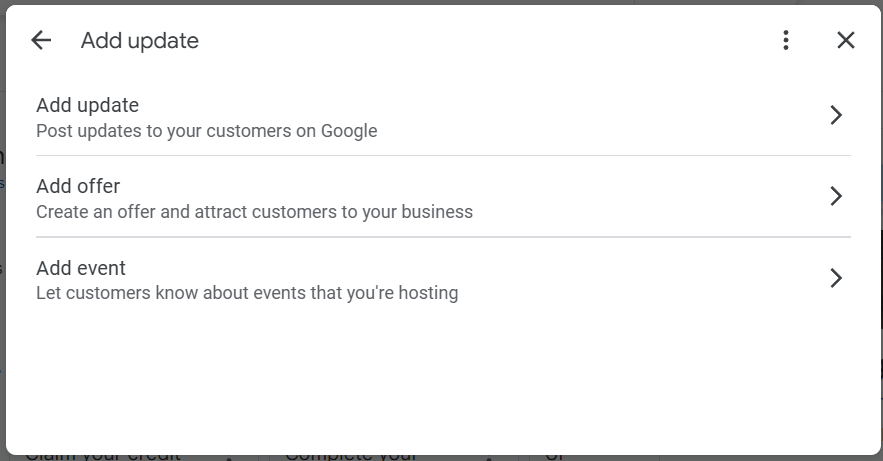
Google gives priority to active, regularly updated profiles. Consistently posting updates signals to Google that your agency is engaged, current, and relevant — and that directly helps your local rankings. Weekly posts can include new blog articles, service spotlights, client success stories, special offers, digital marketing tips, or industry news.
Here is why weekly updates matter:
- Fresh content signals relevancy: Google ranks businesses higher when they regularly post content related to their field — an active profile is treated as a trustworthy profile
- Engage potential clients: Posts give visitors a reason to spend more time on your profile and reach out — they can see your expertise before even visiting your website
- Keywords create additional relevance: Use your posts to naturally highlight targeted phrases like “local SEO services,” “Google Maps ranking,” “social media marketing,” and “digital marketing agency in [your city]”
- Showcase your work: Share campaign results, before-and-after ranking improvements, or client milestones — this builds authority and demonstrates real expertise to both Google and potential clients
Stay consistent with your posting schedule, and your Google Business Profile will reflect your agency’s activity, knowledge, and relevance — giving you a clear competitive edge over agencies that set up their profile once and never return to it. relevance, giving you an edge in the competitive landscape of local SEO for Alabama law firms.
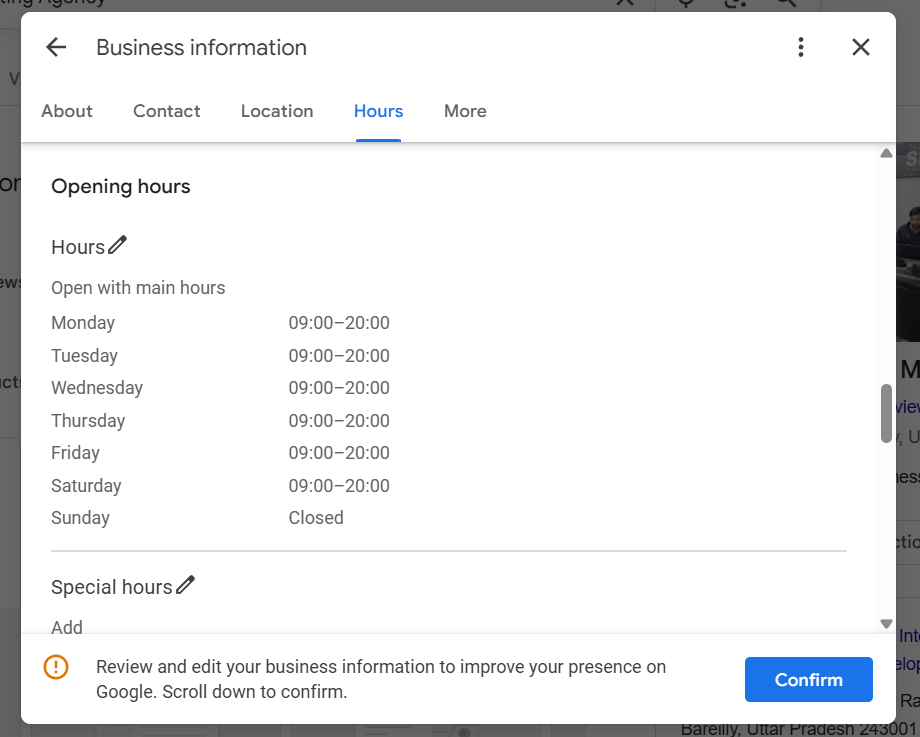
Business Hours — Small Detail, Big Impact
Accurate business hours are a small detail that carries significant weight. Incorrect hours frustrate customers who arrive at a closed business, and they signal poor profile management to Google. Keep your hours updated for your regular weekly schedule, public holidays, and any temporary changes. Google displays “Usually open” or “Closed now” badges in real time based on your listed hours — make sure those badges always reflect reality.
Q&A Section — Answer Before They Even Ask
The Q&A section of your GBP appears directly in local search results, and many businesses completely ignore it. Proactively add and answer the 10–15 most common questions your customers ask — things like “Do you offer free consultations?”, “What areas do you serve?”, “How much do your services cost?” and “Do you work with small businesses?” This content feeds directly into Google AI Overviews and voice search responses, giving you an extra visibility advantage that your competitors are most likely missing.
Important Tip: Respond to every client review — positive or negative — within 24 hours. Enable GBP Messaging so potential clients can reach you directly from Google Maps without needing to visit your website first. Fast, professional responses send strong engagement signals to Google and convert curious searchers into paying clients faster than any ad ever could.
Step 2: Local Keyword Research
Great rankings start with great keyword research. In 2026, local keyword research is about understanding how your customers think, speak, and search — especially as voice search and AI chatbots change the way people phrase their queries.
Types of Local Keywords to Target
How to Find the Right Keywords
1. Google Autocomplete
Type your service and city into Google and let autocomplete show you what real people are searching. Every suggestion is a potential keyword. Do this for 10–15 different service variations.
2. People Also Ask (PAA)
The PAA box in Google search results shows the exact questions people ask about your topic. Each question is a keyword opportunity and a potential FAQ for your website and GBP.
3. Competitor GBP Audit
Look at the top-ranking businesses in your Google Maps area. Examine their categories, descriptions, and the keywords appearing in their customer reviews. This shows you exactly what terms Google is already rewarding.
4. Google Keyword Planner
Use Google Keyword Planner — it’s free with a Google account — to check search volumes for your target keywords. Filter by your city or state to see local-specific data.
5. Review Mining
Read your own customer reviews and your competitors’ reviews. The language customers use to describe your business is pure keyword gold — because those are the exact words other potential customers type into Google.
6. Long-Tail Conversational Focus
Short keywords like “SEO Bareilly” are highly competitive. Long-tail phrases like “affordable local SEO services for small businesses in Bareilly” have lower competition and much higher purchase intent. These also align perfectly with how AI search tools respond to queries.
Step 3: NAP Consistency — The Trust Foundation of Local SEO
NAP stands for Name, Address, Phone Number — and it is one of the most underrated yet critical elements of local SEO. Google actively cross-checks your NAP data across hundreds of websites, directories, and data aggregators to verify that your business is legitimate and trustworthy.
When your NAP is consistent everywhere, Google gains confidence in your business and rewards you with better rankings. When it is inconsistent — different phone numbers on different sites, old address on Justdial, slightly different business name on IndiaMart — Google’s trust drops, and so does your ranking.
NAP Consistency Checklist
✅ Check NAP consistency across Bing Places, Apple Maps, Facebook, and LinkedIn in addition to Indian directories⚠️ Warning: Inconsistent NAP data is one of the most common — and most damaging — local SEO mistakes. It confuses Google’s verification process and can prevent your business from ranking in the Map Pack, regardless of how well you have done everything else. Audit your NAP across all platforms at least once every quarter.
✅ Business name must be identical on Google, your website, Justdial, Sulekha, IndiaMart, and every other directory — no abbreviations, no variations
✅ Phone number format must be consistent — always use +91-XXXXXXXXXX format
✅ Address must match exactly — if your GBP says “Shop No. 5, Civil Lines,” every listing must say exactly the same
✅ Your NAP must appear as text in your website footer — not as an image (Google cannot read text inside images)
✅ If you changed your address, phone number, or business name — update every single listing immediately
✅ Implement LocalBusiness Schema markup on your website with your exact NAP data
Step 4: Build and Manage Online Reviews
If GBP optimization is the foundation of local SEO, reviews are the walls. They are a direct ranking factor for Google Maps, and they influence every other local ranking signal as well.
Google evaluates your reviews across three primary dimensions:
- Quantity: How many reviews does your business have compared to competitors?
- Rating: What is your average star rating? (Businesses below 4.0 stars struggle to rank in Top 3)
- Recency: When was your last review? Fresh reviews carry significantly more weight than old ones
But there is a fourth dimension that most businesses miss — review keywords. When customers mention your services, location, and relevant terms in their reviews (e.g., “Sachin is the best SEO expert in Bareilly, he helped us rank on Google Maps”), those keywords directly strengthen your local relevance signals.
How to Get More Reviews Ethically
Step 1: After completing a service or sale, ask your customer directly: “Would you mind leaving us a quick Google review? It really helps our small business.” The best time to ask is immediately after a positive interaction.
Step 2: Send a direct Google review link via WhatsApp, SMS, or email. Create a short link using Google’s review link generator and make it easy for customers to click and review in seconds.
Step 3: Create a QR code that links directly to your Google review page. Print it on your visiting card, invoice, packaging, and at your physical location. One scan = one review opportunity.
Step 4: Respond to every single review — positive and negative — within 24 hours. Thank customers who leave positive reviews by name. For negative reviews, respond professionally, address the concern, and offer to resolve the issue.
Step 5: Make reviews part of your standard business process — not a one-time campaign. Train your team to ask for reviews consistently. Businesses that generate steady, recent reviews outperform those who get 50 reviews at once and then nothing for six months.
Step 5: On-Page Local SEO — Make Your Website a Local Authority
Your Google Business Profile and your website must work together as a single system. Your GBP gets you into the Map Pack; your website’s local SEO signals confirm your authority and relevance to Google, and drive additional organic traffic from local keyword searches.
Location Page Optimization
If you serve multiple cities or neighborhoods, each one deserves its own dedicated landing page — not a single page with the city name swapped.
Here is how to build a strong location page:
- URL:
/seo-services-bareilly/or/digital-marketing-agency-lucknow/ - H1 Tag: Combine service + city: “Best SEO Services in Bareilly, Uttar Pradesh”
- Content: Minimum 600 words of unique, locally-relevant content
- Google Maps Widget: Embed your actual Google Maps pin on every location page
- NAP Block: Include your full address and phone number as text on every location page
- Local Testimonial: Feature a genuine review or case study from a customer in that specific city
- Internal Links: Link to your main services pages and other relevant blog posts❌ Never copy-paste the same content across multiple location pages with just the city name changed. Google detects this as thin, duplicate content and it will hurt — not help — your rankings.
Essential On-Page SEO Elements
Step 6: Schema Markup — Speak Google’s Language
Schema markup is structured data code that you add to your website to tell search engines exactly what your business is, what it does, and what information it holds. In 2026, schema is no longer optional. It is a critical factor for both traditional local rankings and Google AI Overview visibility.
When Google’s AI Overview is generating an answer for a local search query, it pulls structured, reliable information from pages that have proper schema markup. Without schema, your content may be ignored entirely — even if it is excellent.
Priority Schema Types for Local Businesses
Implement LocalBusiness and FAQPage schema immediately — they will have the most immediate impact on your AI Overview and Map Pack visibility.
💡 Verify Your Schema: Use Google’s free Rich Results Test Tool to check that your schema is implemented correctly and eligible for rich results in search.
Step 7: Local Link Building and Citations
Citations are online mentions of your business Name, Address, and Phone Number on external websites — directories, news sites, blogs, and industry platforms. They are a prominence signal — the more consistent, high-quality citations you have, the more Google trusts that your business is legitimate and established.
Top Indian Citation Sources to Submit Your Business
Start with these high-authority platforms — all of them are trusted by Google as authoritative local data sources:
- Justdial — India’s largest local business directory
- IndiaMart — Leading B2B platform, high domain authority
- Sulekha — Major local services platform
- TradeIndia — Strong B2B citation source
- Bing Places for Business — Bing’s equivalent of Google Business Profile
- Apple Maps / Apple Business Connect — Increasingly important as iPhone usage rises
- Facebook Business Page — Social citation with high authority
- LinkedIn Company Page — Especially valuable for B2B businesses
Submit your business to at least 20 high-quality directories in your first month. After that, focus on acquiring 5–10 new citations each month.
Local Link Building Strategies
- Get featured in local news: Reach out to local journalists, news websites, and Bareilly/UP-based blogs. Offer your expert opinion on local business trends. A single mention on a reputable local news site is worth 20 directory citations.
- Sponsor local events: Support local school events, business conferences, or community initiatives. Event websites typically link back to sponsors — these are highly trusted local links.
- Partner with complementary businesses: If you are an SEO agency, partner with a web design firm, a photographer, or a print shop. Cross-link each other’s websites for mutual SEO benefit.
- Publish original local research: Conduct a small survey about digital marketing trends among businesses in your city. Publish the data on your blog. Other local websites will naturally link to original data.
Step 8: Content Strategy for Local SEO
Publishing consistent, locally-relevant content is the engine that drives sustainable local SEO growth. Content serves a dual purpose in 2026: it builds topical authority for traditional organic rankings AND creates the answer-rich material that AI platforms like Google AI Overviews and Perplexity pull from when recommending local businesses.
Blog Content Ideas for Local Businesses
Use these four proven content templates to generate blog topics that rank:
- “Best [Service] in [City]: Top 5 Options Compared”
→ Example: “Best SEO Agencies in Bareilly: Top 5 Compared for 2026” - “How Much Does [Service] Cost in [City] in 2026?”
→ Example: “How Much Does Local SEO Cost in Lucknow in 2026?” - “Complete Guide to [Service] for [City] Businesses”
→ Example: “Complete Guide to Google My Business for Bareilly Shops” - “Case Study: How [Local Business] Achieved [Result] with [Service]”
→ Example: “Case Study: How a Bareilly Clinic Got 200% More Calls with Local SEO”
Step 9: Track Your Local SEO Performance
You cannot improve what you do not measure. Tracking your local SEO performance is not optional — it is what separates businesses that continuously improve from those that plateau.
Key Metrics and the Tools to Track Them
Set SMART Local SEO Goals
Every month, set specific, measurable goals. Examples:
- “Reach top 3 Google Maps position for ‘SEO services in Bareilly’ within 60 days”
- “Increase GBP phone calls by 25% within 3 months”
- “Generate 10 new Google reviews in the next 30 days”
- “Publish 4 locally-optimized blog posts this month”
Review your metrics every Monday morning and adjust your strategy based on what the data shows.
Local SEO 2026: Your Quick-Action Checklist
Use this as your ongoing execution guide:
Daily Tasks
- Respond to all new Google reviews within 24 hours
- Respond to all GBP messages within 1 hour
Weekly Tasks
- Upload 3–5 new photos to your Google Business Profile
- Publish one GBP post (offer, tip, news, or customer story)
- Check GBP Insights for any unusual drops in views or calls
Monthly Tasks
- Build 5–10 new directory citations
- Publish at least one locally-optimized blog post
- Review keyword rankings and adjust content strategy
- Follow up with recent customers to request reviews
Quarterly Tasks
- Refresh and update your top 5 performing blog posts
- Audit NAP consistency across all platforms
- Test new schema types and monitor AI visibility
- Conduct a full GBP audit — add new services, update photos, refresh description
Common Local SEO Mistakes to Avoid in 2026
Even experienced marketers make these errors. Avoid them to protect your rankings.
- Keyword stuffing your GBP business name — Actively penalized after the March 2026 spam update
- Duplicate location pages with copied content — Google treats this as thin, duplicate content
- Ignoring negative reviews — Every negative review is an opportunity to demonstrate professionalism
- Inconsistent NAP across platforms — Even small differences can confuse Google’s verification system
- Buying fake reviews or backlinks — More detectable than ever in 2026, risking permanent listing suspension
- Non-mobile-optimized website — 76% of local searches happen on mobile devices
- Setting up GBP once and forgetting it — Google rewards active, regularly updated profiles
- Targeting only one or two keywords — Cover all six keyword types for comprehensive local visibility
Conclusion
Local SEO in 2026 is not a one-time task — it is an ongoing commitment to making your business the most visible, most trusted, and most recommended option in your area, across both traditional search and AI-powered discovery platforms.
Every step in this guide — from optimizing your Google Business Profile and building genuine reviews, to implementing schema markup and publishing locally-relevant content — works together as a system. Skip one part and the whole system underperforms. Execute all of it consistently, and your business will dominate Google Maps in your market.
The businesses winning on Google Maps in 2026 are not the biggest or the wealthiest — they are the ones who show up consistently, earn trust genuinely, and keep improving every single week. That business can absolutely be yours.